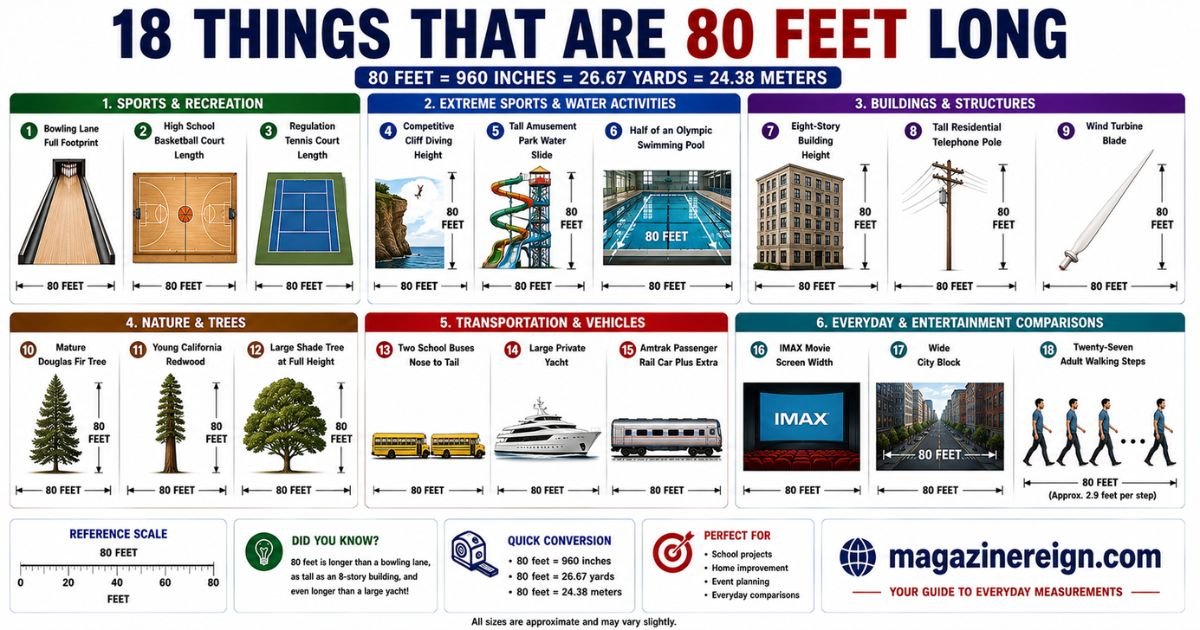
How long is 80 feet, really? It’s a distance that’s surprisingly easy to underestimate until you compare it to something familiar. This guide covers 18 real, everyday things that are 80 feet long, grouped into simple categories so you can visualize this exact measurement clearly.
How Long Is 80 Feet? (Quick Conversion)
| Unit | Equivalent to 80 Feet |
|---|---|
| Feet | 80 ft |
| Inches | 960 in |
| Yards | 26.67 yd |
| Centimeters | 2,438.4 cm |
| Meters | 24.38 m |
Did you know? This 80-foot measurement is a large length, common across sports courts, buildings, and tall trees.
Quick Reference List: 18 Things That Are 80 Feet Long
| Category | Common Objects |
|---|---|
| Sports & Recreation |
|
| Extreme Sports & Water Activities |
|
| Buildings & Structures |
|
| Nature & Trees |
|
| Transportation & Vehicles |
|
| Everyday & Entertainment Comparisons |
|
Here is every item this guide covers, grouped by category for quick scanning.
Sports & Recreation Distances Close to 80 Feet
Sports venues offer some of the clearest, most consistent 80-foot references.
Bowling Lane Full Footprint
A standard bowling lane’s playing surface, from the foul line to the head pin, measures 60 feet long. Adding the back approach area, where bowlers walk before releasing the ball, along with the pinsetter pit behind the pins, brings the total footprint to exactly 80 feet.
The United States Bowling Congress sets these exact dimensions to balance human throwing mechanics with how a ball curves across the oiled lane surface. Looking down a full bowling lane, from the back wall to the far wall, offers one of the clearest indoor references for this measurement.
High School Basketball Court Length
A regulation high school basketball court, following NFHS guidelines, measures 84 feet long, just slightly longer than the full 80-foot mark. This extra length gives teenage players enough room to transition between offense and defense without excessive fatigue.
Standing at one baseline and looking toward the far hoop offers a strong visual sense of this near-80-foot distance. Public high school gymnasiums across the USA are commonly built to this exact court standard.
Regulation Tennis Court Length
A regulation tennis court measures 78 feet long from baseline to baseline, landing just short of the full 80-foot mark. This length applies to both singles and doubles play under official court specifications.
Tennis facilities across the country are built consistently to this standard, making courts a reliable visual reference. Watching a match and picturing that baseline-to-baseline distance offers a close approximation of the full 80-foot measurement.
Extreme Sports & Water Activities Reaching 80 Feet
Some of the most thrilling activities in the USA are built around this exact 80-foot scale.
Competitive Cliff Diving Height
Professional cliff diving competitions commonly set platform heights close to 80 feet above the water’s surface. This height represents roughly the outer edge of what the human body can safely withstand entering water at freefall speed without specialized deceleration equipment.
Divers enter the water at speeds exceeding 50 miles per hour after falling from this exact height. This makes competitive cliff diving one of the most intense, high-stakes examples of the 80-foot measurement.
Tall Amusement Park Water Slide
Many tall, thrill-focused water slides at American amusement parks reach close to 80 feet from the top platform to the splash pool below. These slides are engineered to deliver high speed while keeping riders safely within structural limits.
Riders climbing the stairs to the top of a slide this tall get a genuine physical sense of the full height. This comparison links the 80-foot measurement to a genuinely exciting, adrenaline-driven experience.
Half of an Olympic Swimming Pool
An Olympic-size swimming pool measures 164 feet long under international competition standards. Roughly half that distance, close to 82 feet, lands almost exactly at the full 80-foot mark.
Competitive swimmers train and race across distances tied directly to this pool length every season. This comparison offers a sports-based way to picture 80 feet using a facility many Americans have visited.
Buildings & Structures That Reach 80 Feet
Everyday architecture and infrastructure across the USA often land right at this exact height.
Eight-Story Building Height
Most building floors measure close to 10 feet from finished floor to finished ceiling, including space for structural framing and utilities. That places an eight-story building right around the full 80-foot height mark.
This height is common across mid-size apartment buildings and commercial structures in cities nationwide. Standing at street level and looking up at a building this tall offers a clear vertical sense of the full 80-foot measurement.
Tall Residential Telephone Pole
Some taller utility and telephone poles reach close to 80 feet in height, especially in areas requiring extra clearance for power lines. These poles are engineered to support both electrical and communication cables safely above ground traffic.
Looking straight up at a pole this tall gives a genuine sense of the full vertical distance. This comparison connects the 80-foot measurement to a common, easily spotted structure across American neighborhoods.
Wind Turbine Blade
Many wind turbine blades used in modern wind farms measure close to 80 feet long, contributing to the massive scale of these renewable energy structures. Each blade rotates continuously to convert wind movement into usable electricity.
Seeing one of these blades transported on a highway trailer offers a striking, real-world sense of its true length. This comparison shows how modern engineering directly incorporates the 80-foot measurement into everyday infrastructure.
Nature & Trees Close to 80 Feet
Nature offers some of the most striking 80-foot comparisons across the country.
Mature Douglas Fir Tree
A Douglas fir tree between 50 and 80 years old commonly reaches close to 80 feet in height. This growth results from decades of phototropic competition, as younger trees stretch upward to reach available sunlight within dense forest canopies.
These trees are especially common across the Pacific Northwest region of the United States. Standing beneath one gives a genuine, physical sense of how tall 80 feet truly is.
Young California Redwood
A young coastal redwood tree, still decades away from full maturity, commonly reaches close to 80 feet tall during its early growth phases. Mature redwoods eventually grow far taller, but this height still represents a substantial early milestone.
Redwoods are famous for growing primarily along the Northern California coastline near consistent moisture and fog. This comparison offers a striking natural reference for anyone who has visited a redwood forest.
Large Shade Tree at Full Height
Many large shade trees found in American parks and older neighborhoods can reach close to 80 feet tall at full maturity. Species like sycamores and certain oaks commonly grow into this height range over several decades.
These trees are frequently found lining streets and providing significant canopy coverage in residential areas. Their height offers an accessible, everyday natural reference for this exact vertical measurement.
Transportation & Vehicles That Measure 80 Feet
Common vehicles and rail equipment offer some of the clearest 80-foot references.
Two School Buses Nose to Tail
A standard American school bus measures close to 40 feet long from bumper to bumper. Parking two of these buses nose to tail brings the combined length to exactly the full 80-foot mark.
Most adults have seen or ridden in a school bus at some point in their lives, making this comparison instantly familiar. That shared visual memory is what makes two buses lined up such a reliable reference for this measurement.
Large Private Yacht
Many large private yachts measure close to 80 feet in total length, placing them among the bigger vessels found at marinas along the American coastline. These yachts often include multiple decks, private cabins, and extended cruising range.
Marina slips designed for vessels this size are built specifically to accommodate the full 80-foot length. This comparison shows how much space this measurement can occupy on the water.
Amtrak Passenger Rail Car Plus Extra
A standard Amtrak passenger rail car measures close to 85 feet long, just slightly longer than the full 80-foot mark. These cars are engineered to maximize passenger seating while staying compatible with existing rail infrastructure.
Standing beside a single rail car at a station platform offers a strong sense of this near-80-foot length. This comparison connects the measurement to a common form of long-distance travel across the country.
Everyday & Entertainment Comparisons for Visualizing 80 Feet
These simple, relatable comparisons make 80 feet easy to picture without any tools.
IMAX Movie Screen Width
Many traditional IMAX movie screens measure close to 80 feet wide, creating an immersive viewing experience that fills a viewer’s entire field of vision. This scale is part of what makes IMAX films feel dramatically larger than standard theater formats.
Sitting in an IMAX theater and looking at the full width of the screen offers a genuinely striking sense of this measurement. This comparison connects 80 feet to a widely recognized entertainment experience across the USA.
Wide City Block
Some wider city blocks in American downtown areas measure close to 80 feet from one side street to the other. This width varies significantly depending on the city’s original street planning and grid design.
Walking the width of a block this size gives pedestrians a real sense of urban scale. This comparison offers a practical, everyday way to estimate distance while navigating a city on foot.
Twenty-Seven Adult Walking Steps
An average adult walking stride covers close to 3 feet of ground per step. Taking about twenty-seven steps in a straight line covers close to the full 80-foot distance.
This method offers a quick, tool-free way to estimate length while standing in any open space. It remains one of the most practical, repeatable comparisons for everyday situations.
FAQs Section
How many inches are in 80 feet?
There are exactly 960 inches in 80 feet, a length often used in sports and construction.
How many meters is 80 feet?
80 feet converts to approximately 24.38 meters, close to an eight-story building.
How long is a bowling lane including the approach?
The full bowling lane footprint, including approach and pit, measures 80 feet.
How does 80 feet compare to a basketball court?
A high school basketball court measures 84 feet, just slightly longer than 80 feet.
How many school buses equal 80 feet?
About two standard school buses parked nose to tail equal 80 feet.
Conclusion
The 80-foot measurement, or 960 inches, appears constantly across sports venues, buildings, nature, and vehicles throughout the USA. Comparing it to familiar items like bowling lanes, school buses, and Douglas fir trees makes the length far easier to picture than numbers alone. Next time you need to estimate 80 feet without a tape measure, these 18 references offer a quick, reliable guide.
Also Read It : Alpha Male Quotes And Dark Quotes And New Months Quotes And Hump Day Quotes And Charlie Kirk Quotes

John Smith is the founder and editor of CoolMagazineHub.com, a growing online platform dedicated to helping people discover the meanings, origins, and perfect words behind every kind of message and expression.
With a genuine passion for language and human connection, John created CoolMagazineHub to be a go-to resource for anyone looking to communicate more meaningfully — whether it’s finding the right birthday wish, understanding the deeper meaning of a quote, or crafting the perfect message for a loved one.
John believes that words carry more power than most people realize. Through carefully researched articles, curated message collections, and thoughtful content, he works to make meaningful communication accessible to everyone — regardless of age, background, or occasion.
When he’s not writing or managing the site, John is exploring the rich world of language, symbolism, and the stories that words tell.
“The right words at the right time can change everything.” — John Smith, Founder of CoolMagazineHub.com



1 thought on “18 Common Things That Are 80 Feet Long”