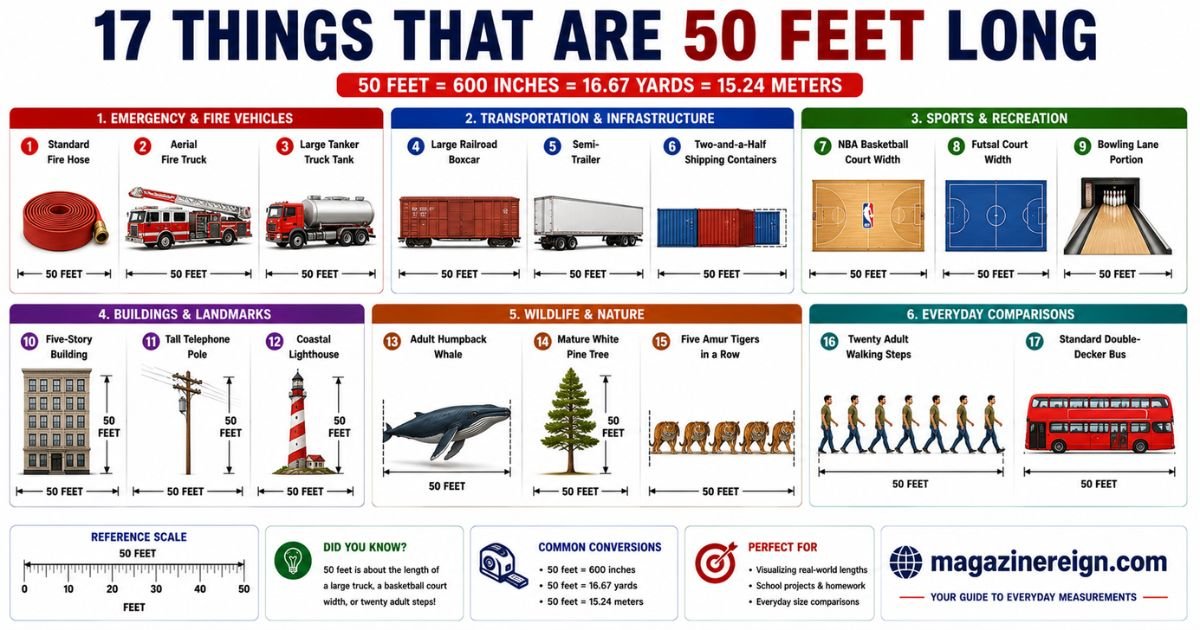
How long is 50 feet, really? This length sits in an awkward middle ground that’s genuinely hard to picture without a clear reference. This guide covers 17 real, everyday things that are 50 feet long, grouped into simple categories so you can visualize this exact measurement clearly.
How Long Is 50 Feet? (Quick Conversion)
| Unit | Equivalent to 50 Feet |
|---|---|
| Feet | 50 ft |
| Inches | 600 in |
| Yards | 16.67 yd |
| Centimeters | 1,524 cm |
| Meters | 15.24 m |
Did you know? This 50-foot measurement is a large length, common across emergency equipment, sports courts, and tall buildings.
Quick Reference List: 17 Things That Are 50 Feet Long
| Category | Common Objects |
|---|---|
| Emergency & Fire Vehicles |
|
| Transportation & Infrastructure |
|
| Sports & Recreation |
|
| Buildings & Landmarks |
|
| Wildlife & Nature |
|
| Everyday Comparisons |
|
Here is every item this guide covers, grouped by category for quick scanning.
Emergency & Fire Vehicles That Measure 50 Feet
Firefighting equipment is built around this exact 50-foot standard for a reason.
Standard Fire Hose
A single fire hose section, measured from coupling to coupling, is exactly 50 feet long across most North American fire departments. Firefighters connect multiple sections together whenever a fire requires extra reach beyond one hose length.
A fully charged 50-foot hose can weigh well over 100 pounds once filled with pressurized water. This weight makes the standard fire hose one of the most physically demanding examples of this measurement in daily emergency work.
Aerial Fire Truck
A large aerial fire truck, including the cab, turntable, and rear steering section, commonly measures close to 50 feet in total length. This size allows the vehicle to carry the equipment needed for its extending ladder system.
When fully extended, the ladder itself can reach heights of five to six stories during a rescue. Even parked on a street, the truck’s own body offers a strong ground-level reference for the full 50-foot length.
Large Tanker Truck Tank
The cylindrical tank section of a standard fuel tanker truck typically measures between 48 and 50 feet long. This portion alone, separate from the driving cab, carries gasoline, diesel, or other liquid cargo to fuel stations.
Seeing a tanker parked at a highway rest stop makes this length obvious once you look past the cab. This comparison shows how much of a tanker truck’s total footprint comes from the tank alone.
Transportation & Infrastructure Reaching 50 Feet
Heavy-duty transport equipment regularly lands right at this exact length.
Large Railroad Boxcar
A standard high-capacity freight boxcar measures close to 50 feet in interior length, with the exterior shell adding slightly more. This size balances strong cargo capacity with the curve limitations found on most rail lines.
These boxcars commonly haul grain, machinery, and packaged goods across the country. Standing beside one at a rail crossing offers one of the clearest physical demonstrations of this exact distance.
Semi-Trailer
A standard semi-trailer used for hauling freight across highways commonly measures close to 50 feet long. This length allows the trailer to carry tens of thousands of pounds of cargo on a single trip.
Semi-trailers are a constant presence on American interstates and loading docks. Their consistent size makes them a dependable, everyday reference for the full 50-foot measurement.
Two-and-a-Half Shipping Containers
A standard shipping container measures 20 feet long under international sizing rules. Placing two full containers end to end and adding half of a third one reaches almost exactly the full 50-foot mark.
This comparison works well for anyone familiar with cargo yards or storage facilities. It shows how quickly smaller, standardized units can add up to this larger measurement.
Sports & Recreation Distances Close to 50 Feet
Sports courts offer some of the clearest, most consistent 50-foot references.
NBA Basketball Court Width
A regulation NBA basketball court measures exactly 50 feet wide from sideline to sideline. While the court’s 94-foot length gets more attention, the width remains a precise and reliable 50-foot benchmark.
Every professional basketball game is played within this exact horizontal span. Watching a televised game and picturing that full sideline-to-sideline distance offers an instant, accurate sense of the measurement.
Futsal Court Width
A standard international futsal court measures close to 50 feet wide at the upper end of its regulation sizing. Futsal is a fast, technical indoor soccer variant played on a hard court surface.
This width feels tight during a match since five players plus a goalkeeper share the same space. That sense of closeness gives a real, competitive sense of how far 50 feet actually stretches.
Bowling Lane Portion
A standard bowling lane measures roughly 60 feet from the foul line to the pins, so a large portion of that lane, close to 50 feet, still represents a strong reference for this measurement. This distance covers most of the lane a bowler watches the ball travel across.
Standing at the foul line and picturing that same distance ahead gives a strong sense of scale. This comparison works especially well for anyone familiar with bowling alleys.
Buildings & Landmarks That Reach 50 Feet
Everyday structures and famous landmarks alike often land at this exact height.
Five-Story Building
A standard building floor measures close to 10 feet from finished floor to finished ceiling. Five floors stacked together land right at the full 50-foot height, roughly matching a typical five-story apartment building’s roofline.
This height feels genuinely tall when standing directly underneath rather than viewing it from across the street. It offers one of the clearest vertical comparisons for understanding this measurement in an urban setting.
Tall Telephone Pole
Some taller utility and telephone poles reach close to 50 feet in height above ground level. These poles commonly carry both electricity and communication lines through cities and rural areas.
Looking up at a pole this tall gives a clear vertical sense of the full 50-foot measurement. This makes telephone poles a common, easily spotted reference point across American neighborhoods.
Coastal Lighthouse
Many compact coastal lighthouses along the American shoreline stand close to 50 feet tall from base to top. These towers are often built on elevated rock or bluff foundations, which can make them appear even taller from a distance.
Their painted, distinctly shaped towers make them easy to recognize in coastal towns and travel photos. This comparison links the abstract 50-foot measurement to a genuinely memorable, real-world structure.
Wildlife & Nature Close to 50 Feet
Nature offers some of the most striking 50-foot comparisons on Earth.
Adult Humpback Whale
A fully grown humpback whale measures close to 50 feet from the tip of its rostrum to the trailing edge of its tail flukes. This makes the entire animal a direct, living match for this exact measurement.
Placed horizontally, a humpback whale would span the full width of an NBA basketball court from sideline to sideline. This comparison offers one of the most powerful natural demonstrations of the 50-foot distance.
Mature White Pine Tree
A fully mature white pine tree commonly reaches about 50 feet tall, a height these trees can take 40 to 60 years to grow into. White pines are especially common across the northeastern United States and much of the surrounding region.
Standing directly beneath a tree this tall gives a genuine physical sense of the full vertical measurement. This natural reference remains one of the most accessible ways to visualize 50 feet outdoors.
Five Amur Tigers in a Row
An adult Amur tiger typically measures between 8 and 10 feet long from nose to tail. Lining up five of these tigers head to tail reaches close to the full 50-foot distance.
This comparison offers a striking, wildlife-based way to picture the measurement using a single powerful animal repeated in sequence. It highlights just how large one Amur tiger already is on its own.
Everyday Comparisons for Visualizing 50 Feet
These simple, relatable comparisons make 50 feet easy to picture without any tools.
Twenty Adult Walking Steps
An average adult’s relaxed walking stride covers close to 2.5 feet of ground per step. Taking about twenty steps in a straight line covers close to the full 50-foot distance.
This method offers a quick, tool-free way to estimate length on job sites, yards, or open parking areas. It remains one of the most practical, repeatable comparisons for everyday situations.
Standard Double-Decker Bus
A standard double-decker bus measures close to 50 feet long from front to back, with two full passenger levels stacked to save road space. These buses have carried passengers in cities for over a hundred years.
Seeing one parked or passing on a city street offers an immediate, real-world sense of this length. This comparison connects the 50-foot measurement to a globally recognized type of vehicle.
FAQs Section
How can I quickly estimate 50 feet without tools?
Count about 20 relaxed walking steps on flat ground for a close estimate.
How long is 50 feet in meters?
50 feet equals exactly 15.24 meters, close to the width of an NBA court.
Is 50 feet considered a large distance?
It’s moderate outdoors but very long indoors, making comparisons especially useful.
How many car lengths equal 50 feet?
About three to four average-sized cars parked end to end equal 50 feet.
How tall is a 50-foot building in stories?
A typical story measures 10 feet, so 50 feet equals about five stories.
Conclusion
The 50-foot measurement, or 600 inches, appears constantly across emergency vehicles, sports courts, buildings, and wildlife throughout the USA. Comparing it to familiar items like fire hoses, basketball courts, and humpback whales makes the length far easier to picture than numbers alone. Next time you need to estimate 50 feet without a tape measure, these 17 references offer a quick, reliable guide.
Also Read It : Alpha Male Quotes And Dark Quotes And New Months Quotes And Hump Day Quotes And Charlie Kirk Quotes

John Smith is the founder and editor of CoolMagazineHub.com, a growing online platform dedicated to helping people discover the meanings, origins, and perfect words behind every kind of message and expression.
With a genuine passion for language and human connection, John created CoolMagazineHub to be a go-to resource for anyone looking to communicate more meaningfully — whether it’s finding the right birthday wish, understanding the deeper meaning of a quote, or crafting the perfect message for a loved one.
John believes that words carry more power than most people realize. Through carefully researched articles, curated message collections, and thoughtful content, he works to make meaningful communication accessible to everyone — regardless of age, background, or occasion.
When he’s not writing or managing the site, John is exploring the rich world of language, symbolism, and the stories that words tell.
“The right words at the right time can change everything.” — John Smith, Founder of CoolMagazineHub.com



2 thoughts on “17 Common Things That Are 50 Feet Long”