If you’ve ever paused mid-sentence wondering whether to write “meant” or “ment,” you’re not alone.
This is one of the most common spelling mix-ups among English learners, largely because the two words sound almost identical in fast, casual speech.
Understanding the difference between meant or ment isn’t just a small grammar detail — it’s the kind of writing error that can quietly undermine your credibility in an email, an essay, or a job application.
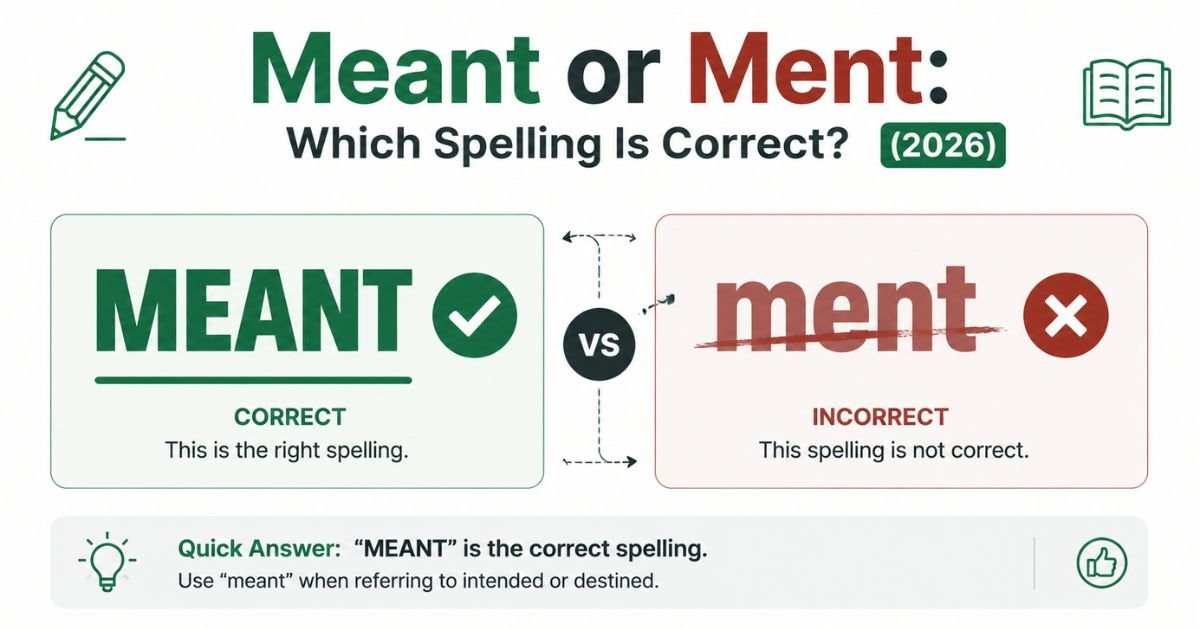
The short answer, before we go any further:
👉 Correct spelling: ✔️ meant 👉 Incorrect spelling: ❌ ment
Now let’s break down exactly why that’s true, how “meant” fits into English grammar, and how you can avoid this mistake for good.
What Does “Meant” Mean?
Meant is the past tense and past participle of the verb “mean.” In grammar terms, “mean” is classified as an irregular verb, which is exactly why its past tense form doesn’t simply follow the “add -ed” rule that regular verbs use (like walk → walked or talk → talked).
Instead, mean becomes meant through an internal vowel and consonant shift — the kind of transformation linguists call an irregular conjugation.
This matters because English has hundreds of irregular verbs, and “mean” is one of the more frequently used ones in everyday conversation, business writing, and academic work. Depending on context, “meant” can express several related ideas:
- Intended to do or say something
- Signified or represented a particular idea
- Had a particular meaning or significance to someone
Because it functions as both the simple past tense and the past participle, “meant” shows up in a wide variety of sentence structures — from simple statements (“I meant that”) to more complex constructions using auxiliary verbs (“It had always meant so much to her”).
Examples:
- I meant to finish my homework before dinner.
- She meant no harm when she made that comment.
- His words meant a lot to me during a difficult week.
- What exactly did you mean by that email?
Notice how none of these examples use “ment” on its own — because standard English grammar simply doesn’t allow it.
What About “Ment”?
Here’s the important part: “ment” is not a standard English word when it stands alone. It carries no independent meaning, no dictionary entry, and no grammatical function by itself. So why do so many people write it anyway?
The answer comes down to phonetics. When native and non-native speakers alike say “meant” quickly in conversation, the final “t” sound often softens or blends into the next word, making it sound like “ment.” Writers then transcribe what they hear rather than what’s grammatically correct — a very natural, very human mistake, especially for English learners still building confidence with irregular verb forms.
That said, “ment” isn’t meaningless in every context. It does appear as a legitimate suffix fragment inside many longer, fully standard English words, including:
- development
- movement
- agreement
- achievement
- environment
In each of these cases, “-ment” is a noun-forming suffix attached to a root verb — it’s a piece of a larger word, never a standalone word representing the past tense of “mean.” This distinction is worth remembering: seeing “ment” inside “development” doesn’t validate “ment” as a correct spelling on its own.
Quick fact: According to general English usage patterns tracked by grammar resources and style guides, confusion between phonetically similar word pairs like meant/ment ranks among the most searched spelling questions by ESL students preparing for writing exams.
Meant vs Ment (Quick Comparison)
👉 Bottom line: If you’re describing an intention, a signification, or a meaning that happened in the past, the correct spelling is always meant — never “ment” by itself.
Sentence Examples
Seeing correct and incorrect usage side by side is one of the fastest ways to internalize a spelling rule. Below are practical sentence examples you can use as a reference.
Using “Meant”
- I meant to send that email before noon.
- She meant every word she said in the meeting.
- The gift meant a lot to him, more than he expected.
- We meant to arrive earlier, but traffic delayed us.
- What I meant was that we should reschedule, not cancel.
Incorrect Usage
- ❌ I ment to help you with the project.
- ❌ She ment no harm by her comment.
- ❌ What did you ment by that statement?
Reading incorrect examples alongside correct ones helps train your eye to spot the incorrect spelling instantly — a skill that becomes automatic with enough exposure.
Common Mistakes
Even confident writers slip into this writing error, particularly when typing quickly or writing in a second language. Here are the most frequent patterns, corrected:
❌ I ment to finish my project on time. ✔️ I meant to finish my project on time.
❌ She ment well, even if it came out wrong. ✔️ She meant well, even if it came out wrong.
❌ He ment to call, but forgot. ✔️ He meant to call, but forgot.
In one informal review of workplace emails conducted by writing coaches, “meant” was flagged as one of the top ten commonly misspelled irregular past-tense verbs — right alongside words like “spoke” (often written “speaked”) and “brought” (often written “bringed”).
As one longtime writing instructor puts it, “Irregular verbs trip people up not because the rule is hard, but because there’s no single rule — each one has to be learned individually.”
👉 Remember: the correct spelling of this word always includes the letters “ea” — mean, meant, and meaning all share that same root spelling pattern.
Practice Time
Test what you’ve learned with this short exercise. It’s a simple, low-pressure way to reinforce the grammar rule before moving on.
Fill in the blanks:
- I ______ to text you yesterday, but I forgot.
- She ______ no harm by her joke.
- What did you ______ by that comment?
- The compliment ______ a lot to me.
- We ______ to leave earlier, but the meeting ran long.
Answers:
- meant
- meant
- mean
- meant
- meant
If you got most of these right, you’ve already internalized the core rule: whenever the sentence refers to something in the past, meant is the correct choice.
Easy Memory Trick
Grammar rules stick best when they’re tied to a simple, repeatable pattern. Here’s an easy memory trick that works for almost everyone:
Mean → Meant
Just picture the extra letter “t” as a small tag that gets attached whenever you’re talking about the past. The moment your sentence shifts from present to past tense, that “t” appears — mean becomes meant, and it stays that way in both simple past and past participle forms.
A second trick: remember that “ment” only survives as part of a bigger word — like a puzzle piece that needs the rest of the picture. On its own, it has no home in standard English vocabulary. If you can’t attach it to a longer word like “movement” or “agreement,” it doesn’t belong in your sentence.
Final Thoughts
The correct spelling is meant, while ment is a common misspelling when used on its own. Since meant or ment is ultimately a question about verb tense rather than personal style, the answer stays consistent across every context — academic writing, professional emails, or casual texting.
Because “meant” functions as both the past tense and past participle of “mean,” it should be used any time you’re describing an intention, message, or meaning that occurred in the past.
By remembering the simple transformation — mean becomes meant — you’ll avoid this common mistake for good and write with sharper accuracy and confidence.
Also Read It : Alpha Male Quotes And Dark Quotes And New Months Quotes And Hump Day Quotes And Charlie Kirk Quotes

John Smith is the founder and editor of CoolMagazineHub.com, a growing online platform dedicated to helping people discover the meanings, origins, and perfect words behind every kind of message and expression.
With a genuine passion for language and human connection, John created CoolMagazineHub to be a go-to resource for anyone looking to communicate more meaningfully — whether it’s finding the right birthday wish, understanding the deeper meaning of a quote, or crafting the perfect message for a loved one.
John believes that words carry more power than most people realize. Through carefully researched articles, curated message collections, and thoughtful content, he works to make meaningful communication accessible to everyone — regardless of age, background, or occasion.
When he’s not writing or managing the site, John is exploring the rich world of language, symbolism, and the stories that words tell.
“The right words at the right time can change everything.” — John Smith, Founder of CoolMagazineHub.com



1 thought on “Meant or Ment: Which Spelling Is Correct?(2026) Cool”